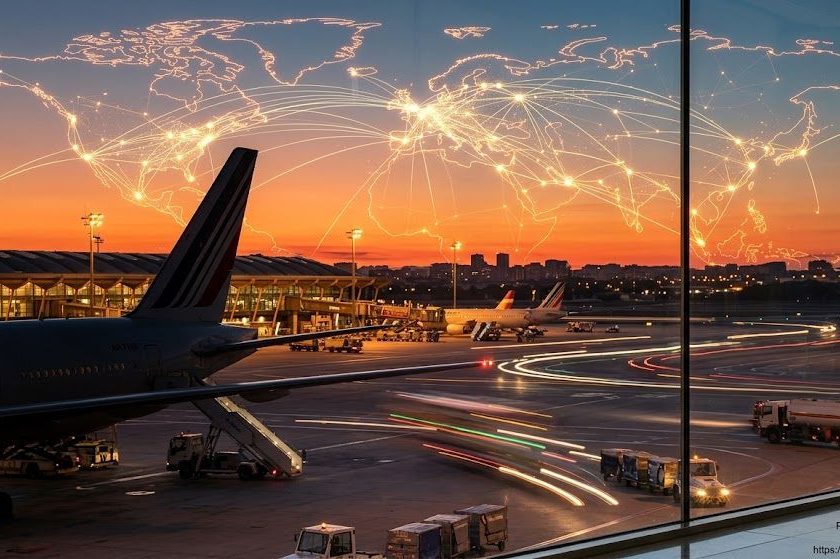

Major airlines no longer connect just cities. They are starting to connect ecosystems capable of generating wealth.
The expansion of Riyadh Air reveals a transformation far deeper than the opening of new routes: aviation is shifting from competing solely for passengers to competing for the interconnection of economic, business, and technological ecosystems. Whoever understands this shift first will redefine the global map of connectivity.
By Ehab Soltan
HoyLunes – Wire services and industry news outlets have accurately recorded the latest moves on the global aeronautical chessboard: the landing at Madrid-Barajas of Riyadh Air’s inaugural flight from Riyadh, its summer connections with Malaga, and the signing of a strategic memorandum of understanding with Air Europa to weave seamless connectivity across Spain. Analysts take note of firm orders placed with Airbus for 60 A321neo aircraft valued at $4 billion, adding to previous orders for Boeing 787 Dreamliners, drafting an initial fleet that aims to surpass 130 aircraft and serve over 100 global destinations by 2030. All of this is backed by the financial muscle of Saudi Arabia’s Public Investment Fund (PIF) under the umbrella of Vision 2030.
All of these facts are important. But none of them truly explain why this is happening. Surface-level journalism stops here. The conventional narrative interprets these movements through the industry’s legacy codes: a new airline breaks into the market, injects capital, buys metal, and fights for seat share.
However, the real story lies neither in the technical specifications of fuselages nor at check-in desks. Commercial aviation is altering the very object of its competition. What we are witnessing is not the birth of an airline; it is the mutation of air transport into an instrument of global geopolitical, economic, and technological architecture.

When Airlines Transported Passengers
For nearly a century, the paradigm of commercial aviation operated under linear rules. Companies essentially competed in a closed ecosystem where success vectors were ticket prices, punctuality rates, onboard service, route capillarity, and fleet efficiency.
Under this historic model, the passenger was treated as a demographic unit of cargo: a volume of traffic to be moved from point A to point B in the most optimized way possible. The industry was structured as an extractive business of pre-existing demand. Airlines sought out flows of tourists or business travelers and deployed capacity in those markets. The airplane was the end, the route was the product, and the ticket was the metric of success. That model still exists, but it no longer explains the decisions of major global airlines.
In a saturated, hyperconnected global economy under unavoidable decarbonization pressures, competing exclusively for seat volume is equivalent to reducing aviation to a mere low-performance public transport service with thin strategic margins.
The New Unit of Competition
The great contemporary breakthrough lies in understanding that major airlines no longer limit themselves to transporting people. They are increasingly competing to become platforms that organize and accelerate international flows of investment, innovation, knowledge, talent, trade, and high-value tourism.
An airline network does not end at the perimeter of the runways; it begins in the socioeconomic dynamics it activates within territories. Just as a physical infrastructure does not generate wealth simply by the weight of its concrete, an airline does not generate development solely through the number of frequencies it operates. The true value of 21st-century aviation lies in its ability to act as an interface for friction reduction between complex ecosystems. Routes are no longer merely transport corridors; they are becoming development corridors.
In an economy where value shifts from the physical to the intangible, an airline’s success is no longer measured by the net volume of passengers transported annually, but by the density, quality, and impact of the human and industrial relationships it manages to spark. The airline ceases to be a transport vector and becomes the connective tissue linking knowledge nodes scattered across the globe.
Routes are no longer merely transport corridors; they are becoming development corridors.**
Riyadh Air as a Symptom, Not an Exception
From this analytical perspective, the emergence of Riyadh Air stops being an exotic anomaly and reveals itself as the clearest symptom of this new era. Riyadh Air itself is not the primary focus—the strategic model it represents is. Riyadh Air matters less as an individual company than as an indicator of the new direction of global aviation. Its investments in Airbus’s A321neo family or Boeing’s Dreamliners, its simultaneous launches in Madrid and Malaga, and its partnerships with European operators are logical pieces of an international architecture under active construction.
The correct strategic question analysts should be asking is not why is this airline buying so many planes with such short delivery timelines? The real question is: what kind of economic geography is it trying to build through this fleet?
By partnering with Air Europa using Madrid-Barajas Airport as a key transit hub, a bioceanic corridor is formed—one capable of channeling capital flows, corporate alliances, and digital innovation projects among three regions that have historically operated in isolation: the Middle East, Southern Europe, and Latin America.

The New Geography of Aviation Power
For decades, the center of gravity of global aviation power was neatly divided between a dominant transatlantic axis (Europe and North America) and a thriving Asia-Pacific block. Today, the physics of connectivity has reorganized around a new central location.
The Persian Gulf region has ceased to be a mere transit zone and has consolidated itself as the planet’s primary distributor of time and space. This historical shift explains the maturation and evolution of the region’s major carriers. Airlines such as Emirates and Qatar Airways were pioneers in demonstrating that a country’s geographical scale does not limit its strategic reach if it successfully turns its airspace into a crossroads of globalization.
Saudi Arabia’s entry into this league does not aim to clone its neighbors’ models, but rather to expand the boundaries of the board. This is not about aggressive competition for the exact same passenger; it is a tectonic shift where the Gulf definitively establishes itself as the connecting infrastructure between Asia, Africa, and Europe. The geography remains the same; what changes is not the map, but who succeeds in giving it economic meaning.
Madrid Can Be Much More Than a Destination
On this map of influence, the Iberian Peninsula—and specifically Madrid—emerges with strategic activation potential that is difficult to replicate. Gulf operators must not view Madrid merely as a source market for cultural or sports tourism—despite the clear impact of sponsorships like the Riyadh Air Metropolitano. Madrid possesses all the credentials to function as the major trilateral hub connecting Europe, Latin America, and the Middle East.
Spain holds structural advantages: a global linguistic community, established diplomatic relations, a network of multinationals deeply rooted in Latin America, and pre-existing transatlantic air connectivity that stands out across Europe.
The agreement signed between Riyadh Air and Air Europa makes total sense in this context. It serves as logistical validation that Madrid can act as an invisible border for talent, investments, and technology projects. Its advantage lies not just in its geographic location, but in its capacity to link economic spaces with existing historical ties—allowing an entrepreneur from São Paulo, a startup from Bogotá, and a research center from Riyadh to meet in a zero-friction environment. Its true asset is not the airport itself, but its power to connect three cultural and economic spheres that already share language, business, and strategic interests.
Latin America Enters a Different Equation
The real conceptual turn introduced by this scenario directly affects Latin America’s standing. Historically, the business press and European alliances have viewed the American continent through a two-dimensional lens: either as a supplier of raw materials and tourists, or as a recipient of traditional corporate investments in sectors like banking or energy.
The connectivity driven by next-generation airlines reshapes this relationship. By shortening distances to the Middle East and Asia through efficient intermediate hubs, Latin America enters a global equation focused on added value.
Flows are no longer limited to leisure travelers; they involve establishing scientific bridges, exchanging patents, enabling the mobility of high-level academic communities, and attracting global sovereign wealth funds seeking to diversify into green transition sectors and advanced agribusiness in Latin America. For the region, this transformation means far more than just having more flights available; it means shortening the economic distance to Asia and the Gulf. Connectivity is no longer measured in miles, but in opportunities.
What an Airline Really Buys When It Buys an Airplane
When the market witnesses multi-billion-dollar deals signed at air shows like Le Bourget or Farnborough, the general tendency is to calculate the acquired transport capacity: how many available seat kilometers are being added to the market.
That analysis is incomplete. A state-of-the-art aircraft never represents just physical payload capacity. Fundamentally, it is a mobile infrastructure of economic and diplomatic influence. Every new airplane expands a country’s sphere of influence far beyond its borders.
When an airline acquires an efficient fleet with transcontinental range, it gains the political and commercial power to determine which cities thrive and which remain isolated. It buys the capacity to project its home nation’s cultural influence, facilitate quiet diplomatic missions, and lay the groundwork for tech parks to flourish. An order for wide-body aircraft is the modern equivalent of signing a free-trade agreement or opening a high-speed diplomatic corridor.

The Invisible Competition
Behind marketing campaigns and cabin rankings, a far more decisive, invisible competition is taking place. The question keeping boardrooms awake is no longer who operates the world’s largest fleet?, but who can connect 21st-century value ecosystems with the highest precision?
Various players with distinct strategies are taking part in this game, all sharing the same conceptual clarity. Global network carriers like Emirates or Qatar Airways continue expanding their long-haul traffic dominance; operators like Singapore Airlines fortify their region’s innovation ecosystem; while legacy groups like IAG (through Iberia’s positioning in Madrid) reshape alliances to ensure their markets do not get cut off from new capital arteries. This is not a fare war; it is a battle for geopolitical relevance in mapping out the world’s knowledge networks.
What Every Nation Should Ask Itself
This systemic transformation elevates the debate to national policy levels. The rise of global airlines acting as ecosystem architects forces any government or regulator to ask a fundamental question:
Do we simply want to attract more flights and fill airport terminals, or do we want to leverage aviation as a strategic tool to transform our economy and retain future talent?
Governments that continue measuring success purely through raw passenger volume metrics will keep managing the physical container while others capture the value of the invisible content. 21st-century aviation is a tool of strategic economic engineering. Any country that fails to design its connectivity around its industrial and innovation goals effectively forfeits its say in the international division of labor.
20th-century airlines connected airports. 21st-century airlines will compete to connect ecosystems.
The Future Does Not Take Off When an Airplane Takes Off
For decades, we thought an airline was simply a company whose mission was to move passengers between two airports. The 21st century demands a complete redefinition of that idea. Major airlines are beginning to look less like mass transport companies and more like architects of new economic geographies. Carrying passengers will remain their operation. Connecting ecosystems will be their true business.
In this new landscape, success will no longer depend on fleet size in hangars, but on the strategic capability to cross-pollinate people, businesses, universities, capital, and knowledge across regions that previously remained disconnected. Flight routes will keep appearing on maps. The real competition will take place between the economic networks those routes manage to activate.
The most important flight of the 21st century will not be the one that links two cities. It will be the one that manages to bring together two economies, two innovation systems, and millions of people who previously never had the opportunity to collaborate.